A work mode is the unit of access in a shared work folder in Treasure AI Studio: a named kind of work — "Report writing", "Curation", "Read-only" — that bundles an access level with the specific top-level folders it may write to. Assigning people to work modes is the only way to grant access to a shared work folder, and every chat in that folder runs as exactly one mode.
Work modes exist because the AI, not just the person, is acting on the files. A mode is the guardrail that decides where an agent may write while it works on that person's behalf: a member working in a "Report writing" mode can ask for anything, but the agent's writes land in reports/ and nowhere else on the folder's shared side. The vocabulary is deliberately the vocabulary of work rather than of permissions, because that is the choice members actually make when they join a folder.
This page is the reference for the model. For the flows that use it, see Sharing a Work Folder (managers) and Using a Shared Work Folder (members).
- A shared work folder (Shared Work Folders)
- Manage access to that folder, to create or change its work modes — assignment to a Manage mode is what makes someone a manager of the folder
Every work mode carries one access level. All four govern the folder's shared side: a member's private area — the my/ directory inside the folder — is always writable, whatever the mode says.
| Access Level | Reads | Writes | Also Grants |
|---|---|---|---|
| View only | The whole folder | Nothing on the shared side | — |
| Custom folders | The whole folder | Only the top-level folders the mode lists, for example reports/ | — |
| Write everywhere | The whole folder | The whole folder | — |
| Manage | The whole folder | The whole folder | The folder's settings: its work modes and their members, its name, description, and visibility, and deleting the folder |
Reading is folder-wide at every level. Work modes allocate writes, never reads, so no part of the folder is hidden from a member except each member's own my/ — plan the folder's contents accordingly.
A mode's access level is fixed when the mode is created. The Edit mode dialog shows the level as text rather than a control, with the hint "Fixed when the mode was created. For a different scope, create a new mode and reassign people to it." Names and writable folders stay editable. Plan a folder's modes with that in mind: widening someone's access means a new mode and a reassignment, not an edit.
A Custom folders mode carries a list of top-level folder names inside the shared work folder — reports, campaigns — and the mode may write in those and nowhere else on the shared side. The rules are strict on purpose, so that a write scope is always readable at a glance:
- Top-level names only.
reportsis valid;reports/2026is rejected with "Only top-level folder names are allowed — remove the '/'." Everything inside a writable folder, at any depth, is writable. - No leading dot. The writable-folders editor refuses
.claudeand other dot-names with "Folder names can't start with a dot.", so a Custom folders mode built in the UI never covers the folder's skills or instructions — maintaining those takes Write everywhere or Manage. myis reserved. It is each member's private area, so it can never be a mode's writable folder.- 255 characters maximum, and no duplicates within one mode. Spaces are allowed; each writable place reaches the agent on its own line, so a folder name cannot be mistaken for two.
- Named folders that do not exist yet are created when you save. The editor marks them "will be created", so a mode can declare the structure it expects rather than waiting for someone to make the directory.
A mode named after its folders is the norm: when you create a mode from the Add people flow, Treasure AI Studio names it after the folders you picked (reports, reports & campaigns, or reports, campaigns +2 for three or more), or View and Write everywhere for those two levels. Rename it to the work it represents whenever the auto-generated name reads thinly — mode names appear on every member's folder page and in each chat.
Every shared work folder is created with two work modes, so neither managing nor sharing starts with authoring a mode:
| Mode | Level | State |
|---|---|---|
| Manage | Manage | The creator is assigned to it. A folder always has at least one manager: the last Manage assignment cannot be removed |
| Read-only | View only | Created unassigned, ready to hand out. It carries no special status — rename, edit, delete, or assign it like any mode you make yourself |
The Manage mode is not editable: its row in Work modes carries the caption "Manage mode always includes folder settings and can't be edited here." You grant management by adding people to it, which asks for a confirmation naming what it grants.
Assignments are managed on the Shared folder settings page, which managers open from a shared work folder's ⋯ menu. Its People section lists each person with the modes they hold and what those modes write to; its Work modes section lists the modes themselves.
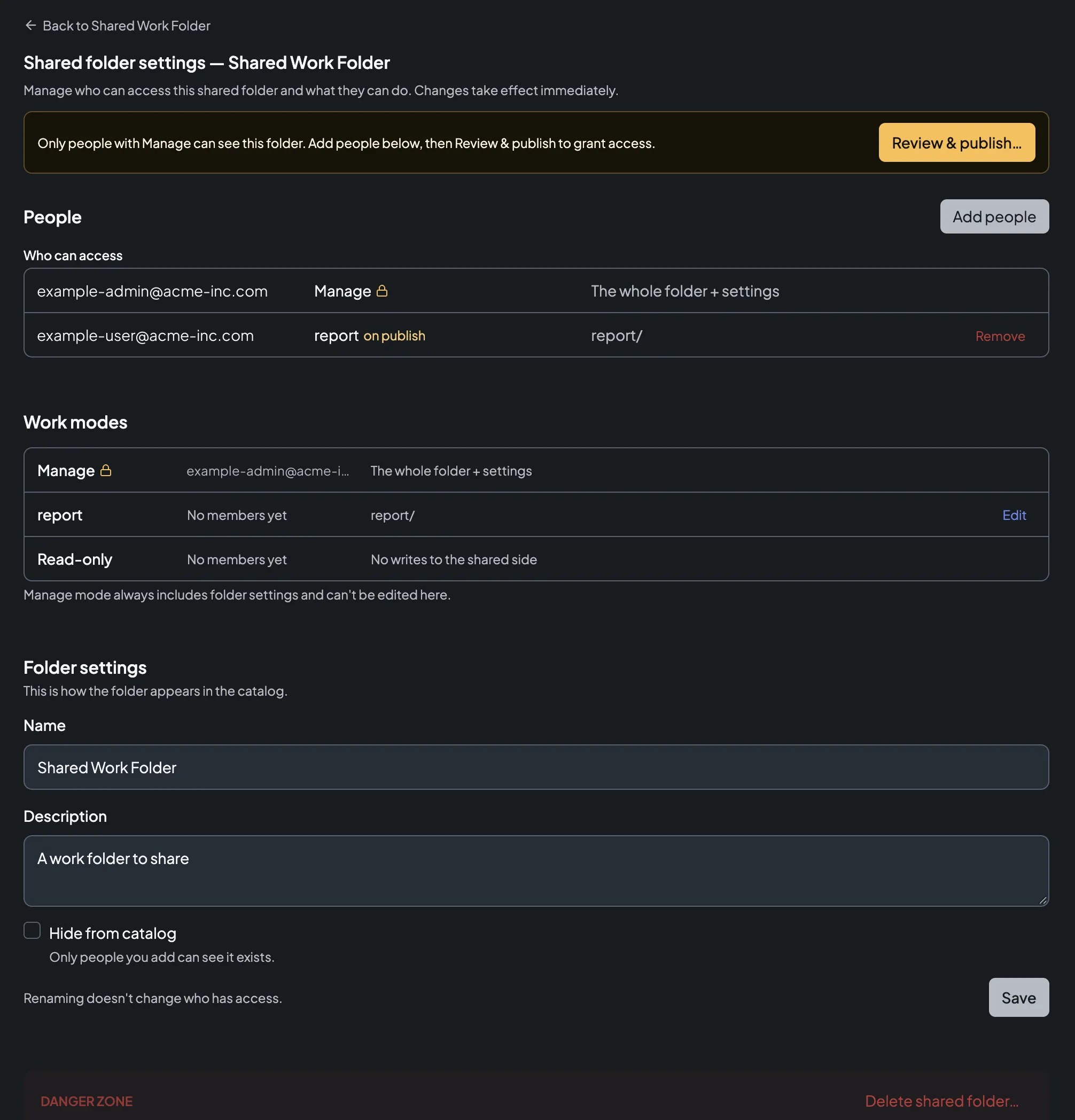
| Action | How It Works |
|---|---|
| Add people | Search your account's people by email, select any number of them, then check the modes they should hold. You can create a new mode inline in the same step by checking New mode and picking an access level and folders. The change is purely additive — people keep the modes they already had |
| Edit one person's modes | Edit on a person's row opens their full list of modes as checkboxes; saving applies exactly what you see. Unchecking everything is refused with a pointer to Remove from folder, which is the deliberate way to take all access away |
| Everyone in the account | A row on any mode that gives that mode to every person in the account, current and future. It is not available on Manage modes, and it makes Hide from catalog pointless, since everyone then holds an assignment and so everyone sees the folder |
| Hand over management | Add the new manager and remove the old one in the same save. The check that a folder keeps at least one manager runs on the result, so a swap never passes through a manager-less state |
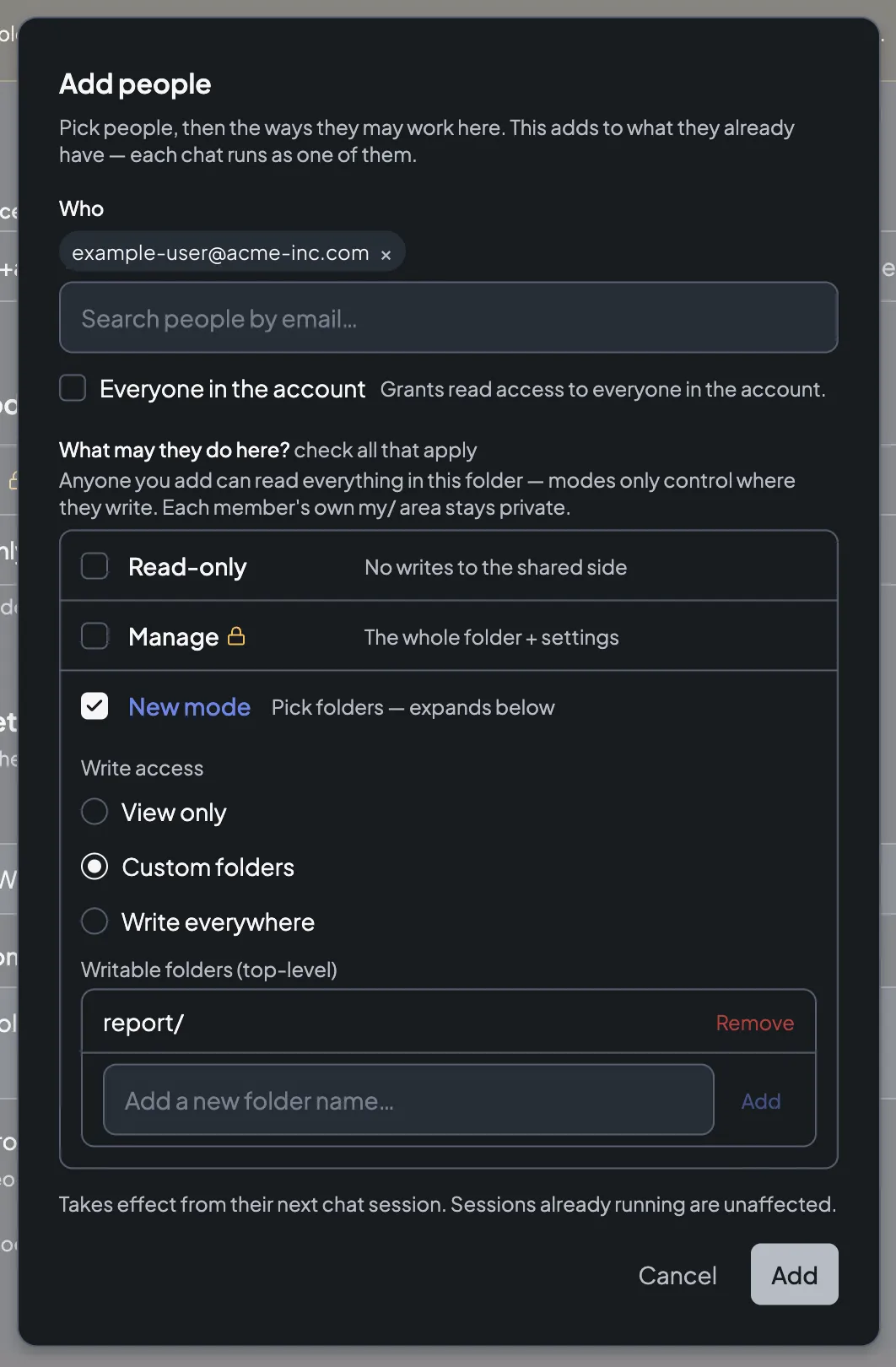
One person can hold several modes — for example Read-only for everyday work and a broader mode for the weeks they curate the folder. Holding several is not the same as using several at once: see How a Chat Chooses Its Work Mode.
Manage grants the folder's settings on top of full write access: the holder can change every mode, add and remove people, rename the folder, and delete it for everyone. Treasure AI Studio therefore pins Manage at the top of the mode list and asks for a separate confirmation before adding anyone to it. Grant it to the people who own the folder's shape, and use Write everywhere for people who only need to write everywhere.
A chat in a shared work folder runs as one work mode, and it is decided before the chat starts — never mid-conversation. Which mode that is comes from your copy of the folder: you pick it when you import the folder, and change it from the mode badge on the folder page. Every chat entry point — New chat, the sidebar +, Ask AI on a file, a scheduled run — uses that same mode, so there is no per-chat mode question to answer.
The file browser is deliberately different from the agent:
| Route | Write Scope |
|---|---|
| Your chats (the AI) | The single mode your copy of the folder is set to. This is the guardrail on the agent — the reason a mode exists |
| The file browser (you, in the UI) | The combined scope of every mode you are assigned, plus my/, which is always yours to write. If you hold both Read-only and a reports mode, you can upload to reports/ from the UI while working in a chat that cannot write there |
The mode picker offers every mode you are assigned, plus any mode whose write scope is contained in one you hold — a Write everywhere holder can choose to work as Read-only for a while, without an assignment for it. Manage is the exception: it is never available by containment, only by assignment.
Saves on the Shared folder settings page apply immediately to the folder's configuration. How fast a member feels a change depends on which of the two planes it lands on, and they do not move at the same speed:
- What the member can reach themselves — the folder page, the file tree, uploads, moves, renames — is the combined scope of every work mode they hold, recomputed each time Treasure AI Studio issues them access. Adding a mode widens that scope right away; nothing has to be restarted.
- What their AI can write is the single mode their copy of the folder is set to, resolved when a chat session starts. A chat keeps the access it booted with until its session ends.
So a member assigned both Read-only and a reports mode can put a file in reports/ from the UI immediately, while a chat they are running as Read-only still cannot write there — and vice versa: taking one mode away narrows the UI at once but leaves running sessions alone.
| Change | Effect |
|---|---|
| Adding modes to a person | Immediate for what they can do themselves — the new mode joins their combined scope, so the folder page lets them write there right away, and it appears in their mode picker. Their AI works under it from their next chat session |
| Editing a mode's name | Immediate everywhere the name is displayed |
| Editing a mode's writable folders | Applies to every member using that mode from their next chat session. The dialog names how many people that is: "This changes access for N people." |
| Deleting a mode | Members using it fall back to view-only access on the shared side, and choose again from the remaining modes. The confirmation names how many imports are affected |
| Removing a person's modes | Immediate, on both planes — see Losing a Work Mode |
| Deleting the shared work folder | Removes it from every member's list. Chats already running are stopped, and the folder's files are permanently deleted |
A chat that is stopped and resumed re-derives the mode, so it comes back under the folder's current mode rather than the one it started with. This is why the in-chat badge names the folder's current mode rather than the mode the chat was created in.
Taking away the mode a member was working in is enforced at every point where new access is handed out, so revocation does not wait for anything. The member keeps the folder in their sidebar — the folder is still imported — but until they switch to a mode they hold:
| Surface | What Happens |
|---|---|
| The folder page | A banner reads "Your work mode for this folder is no longer available. Until you switch modes, its files can't be shown, new chats can't be created here, and other chats can't see this folder." with a Switch mode button, and the mode badge is tinted with "no longer available — switch modes" |
| New chats | Refused. The folder page and the sidebar show "Your work mode for this folder is no longer available — switch modes on the folder page, then try again." |
| Their other chats | The folder drops out of the sandbox, so an agent in another chat can no longer read or write it. The chat whose own folder it is keeps working until its session ends |
| The folder page's file sections | Files, Uploads and Actions and skills fold away entirely. The folder is dropped from the access the file browser is issued, my/ included, so the banner carries the story rather than leaving empty sections behind. Chats stay listed |
| Their schedules in the folder | Each run fails with "The executor's work mode for this folder is no longer available.", and repeated failures auto-disable the schedule. Turning it back on needs an available mode (Action Schedules) |

Deleting a mode is not the same as removing a person: a member whose mode was deleted still holds an assignment, so they fall back to view-only access and keep working. It is losing every assignment in the folder — or holding only a mode you are no longer entitled to — that triggers the state above. Either way, the fix is the member's to make from the folder page, or a manager's by granting a mode again.
Edit on a row in Work modes opens the mode's definition: its name, its access level (displayed, not editable), and — for a Custom folders mode — its writable folders. Membership is not edited here; it belongs to the People section.
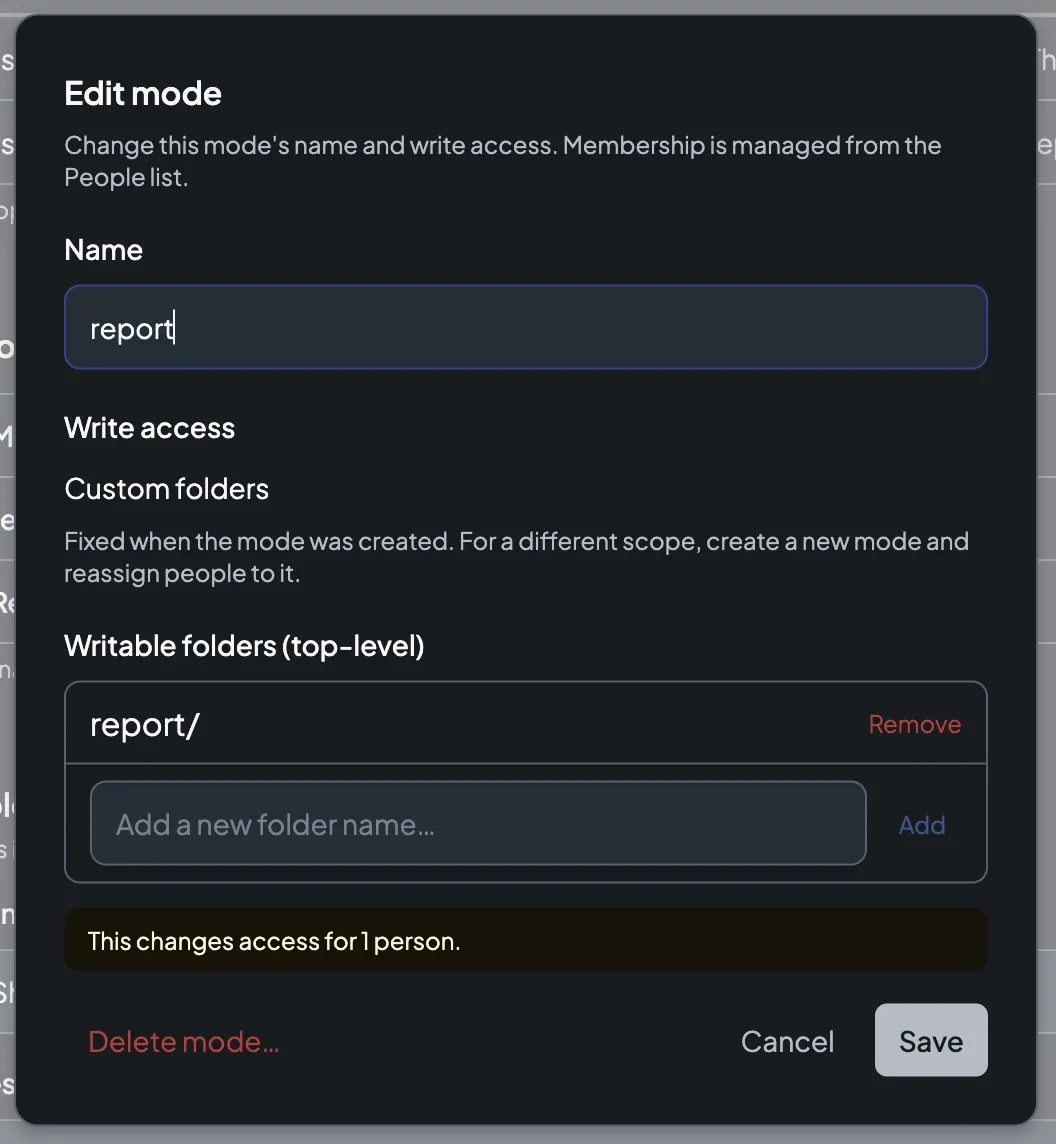
One thing to expect while editing: deleting a mode is allowed even while people are working in it. The confirmation states how many imports use it — those members fall back to view-only and pick another mode themselves. Deleting the folder's last Manage assignment is the one thing refused outright, with "The folder needs at least one manager — add another manager first."
Deleting a mode never touches files. Nothing moves and nothing is removed from the folder; only who may write where changes.
A shared work folder is governed by the people assigned to a Manage mode. Account administrator — the platform role that governs account-level settings such as Custom Instructions — grants nothing inside a shared work folder: an account administrator who holds no work mode in a folder cannot open its settings, cannot read its contents, and does not see it at all while Hide from catalog is on.
Support and operations staff can inspect shared work folders through internal admin tooling for troubleshooting; that path is outside the product UI and is not a way to grant access.
A few patterns that hold up in practice:
- Start with two modes. The seeded Manage and Read-only pair already covers "the people who run the folder" and "the people who read it". Add a writing mode when there is a place for writes to go.
- Name modes after work, not permissions. "Report writing" tells a member what they are choosing; "rw-reports" tells them what an administrator was thinking.
- Give writes the narrowest home that works. A
reports/mode makes a misdirected agent write fail loudly instead of quietly editing reference material. This matters more than it did with a private working directory: a chat starts on the shared side, so whatever the mode allows is where an unqualified write lands. - Do not use modes to hide things. Every member reads the whole folder. Sensitive material belongs in a separate shared work folder — optionally with Hide from catalog on — or in a private work folder.
| Issue | Solution |
|---|---|
| Edit mode shows the access level as plain text, with no way to change it | Access levels are fixed at creation — the dialog states the level and the reason instead of offering a control. Create a new mode with the level you want, move people to it, then delete the old mode |
| "Only top-level folder names are allowed — remove the '/'." | A writable folder is a single top-level name inside the folder. Enter reports, not reports/2026 — everything inside it is writable anyway |
| "Folder names can't start with a dot." | The writable-folders editor does not accept dot-names, so a Custom folders mode cannot be pointed at the folder's .claude/. Use Write everywhere for someone who must maintain its skills and instructions |
| "This mode was changed by someone else." | Another manager saved this mode's definition while your dialog was open (only same-mode edits collide; membership changes never raise this). Your entries are kept and saving again succeeds, overwriting theirs — so check with them first. To keep their version instead, close the dialog without saving and reopen it |
| "The folder needs at least one manager — add another manager first." | You are removing the last Manage assignment. Add the incoming manager in the same save, or before the removal |
| Everyone in the account cannot be switched on for a mode | The mode's level is Manage, where account-wide assignment is not allowed. Use a Write everywhere mode if everyone genuinely needs full write access |
| A member reports that the folder stopped working for them | Their work mode is probably no longer available to them. The folder page states it and offers Switch mode; if they hold nothing else, grant a mode again — see Losing a Work Mode |
- Sharing a Work Folder — Create the folder, curate it, and publish it to the people who need it
- Using a Shared Work Folder — What a work mode feels like from a member's side
- Shared Work Folders — The layout, the catalog, and what is shared versus private
- Access Control — Account-level access alongside folder-level work modes