Joining a shared work folder in Treasure AI Studio gives you a colleague's whole setup — their folder structure, their instructions, their skills and actions, their reference files — as a place you work in with your own AI. You import it once from the catalog, choose the work mode you will work in, and from then on it behaves like any other work folder in your sidebar.
The one habit to build is the my/ boundary. The folder itself is the shared side — every member reads it, and your chats start there — while my/ is the private area that only you can see. Knowing which side you are on tells you who will read what the AI just wrote.
- Signed in to Treasure AI Studio on Web or Desktop (Getting Started)
- A work mode in the folder, granted by one of its managers — without one you can see that the folder exists, but not its contents
- Fewer than 25 active work folders, since an imported shared folder counts toward that limit
The Work folder catalog lists the shared work folders in your account. Open it with the + button next to Work Folders in the sidebar.
Each card names the folder, its managers, and its state, and the card's action tells you where you stand: Import when you hold a work mode and have not imported it yet, Open when you already have, a Setting up tag when the folder's owner is still preparing it and no one else can read it yet, and By invitation when you hold no work mode in it. There is no request button — the detail view names the managers to contact instead.
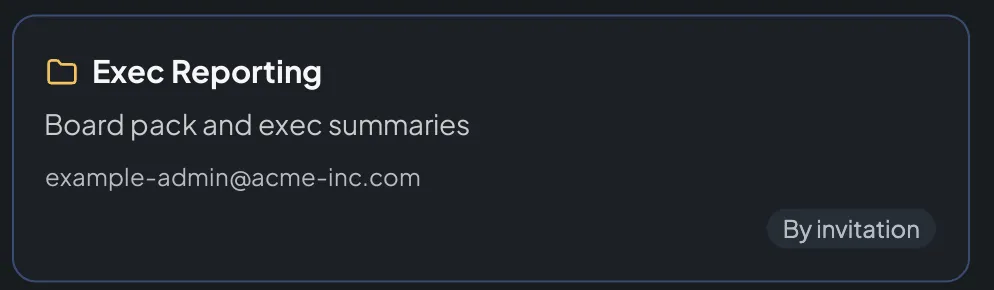
Select a card to open its detail view before deciding. It shows the description, the manager to ask about access, and a preview of the folder's top level. Work modes are listed in two groups: Your work modes, which you may pick from at import, and Other work modes, greyed out with "Ask a manager for access" — so a mode you would need for the work is visible rather than absent. The file preview is only shown if you hold a work mode; otherwise the contents stay behind "Files are listed once you have access." The list also states the access floor plainly: every member can view all of the folder's files, and modes only decide where in it each person writes.
Importing asks you exactly one question — how you intend to work in the folder.
- In the catalog, select Import on the folder's card, or open the card and select Import to my folders.
- In Add {folder name} to your folders, pick the work mode you will work in. Only the modes you may use are listed; a mode whose write scope fits inside one you hold can be chosen even without its own assignment.
- Select Import. The folder appears in the sidebar's Work Folders section with a shared-folder icon and the hint "Shared folder".
- Open the folder page. Unless your modes cover the whole folder, a strip under its name lists every place you can write on the shared side, plus
my/, which always is.
The folder's name, and where it appears, come from the folder itself — there is nothing to name and nothing to configure. Every chat you start in the folder runs in the mode you just chose, and you can change it later.
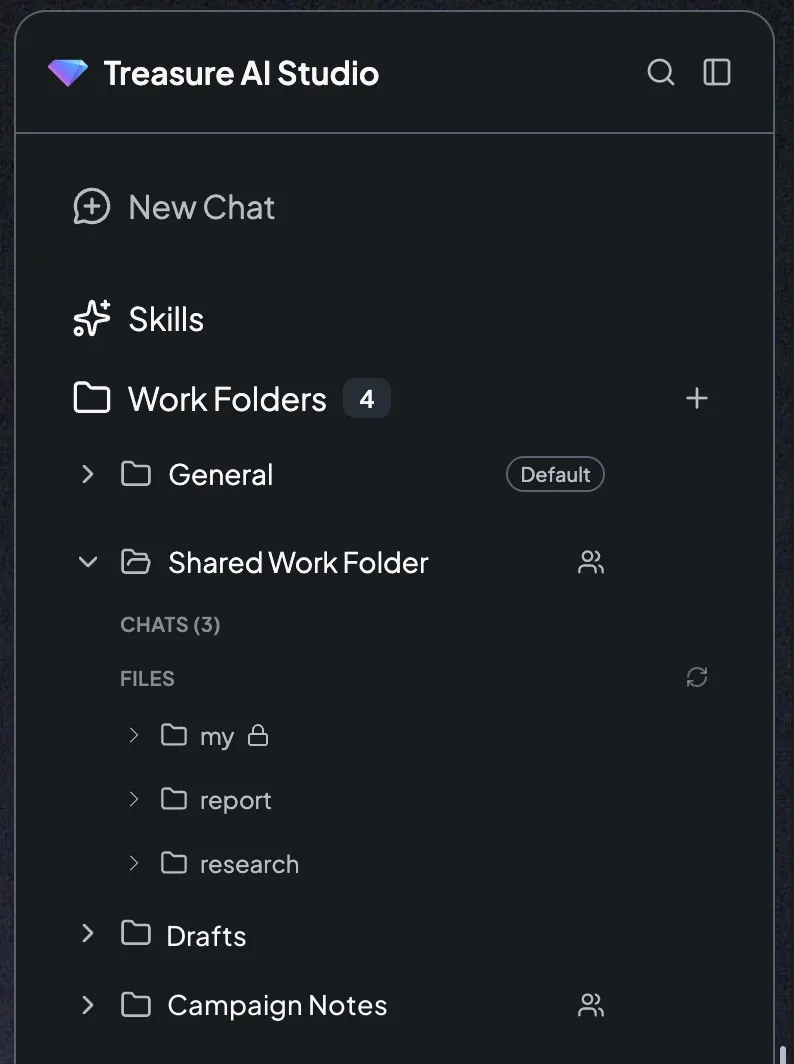
If you already have a private work folder with the same name, the shared one appears as "{name} (shared)" with a Name adjusted badge. Nothing is broken — only your view of the name differs from everyone else's. Select the badge to see "This folder is '{name}' for everyone else", rename your private folder from there, and the shared folder takes its official name with one more click (Use official name).
The folder page shows the two layers explicitly: the folder's own rows, which every member sees, and a my/ row badged Only you.
| Where | Who Sees It | Can You Write There? |
|---|---|---|
| The folder and everything in it | Every member of the folder | Only where your work mode allows |
my/ (your private area) | Only you | Always, whatever your work mode |
Under the folder's name, a strip names every place you can write: You can edit: followed by one chip per writable folder on the shared side, then a my/ (your area) chip, and the reminder "— everything else is view-only". When none of your work modes can write the shared side, that suffix reads "— the rest of this folder is view-only" and is tinted. A long list folds into a +N more chip that names the rest on hover, and a mode that writes the whole folder leaves no boundary to explain, so the strip is not shown at all.
If you hold more than one work mode in the folder, that strip — and every file action you take yourself — reflects the combined scope of all of them, not just the mode you are working in. Your AI is the stricter of the two: a chat runs as one mode, so it writes only where that mode allows. Holding a reports mode alongside Read-only means you can upload to reports/ from the folder page while a chat running as Read-only cannot put anything there.
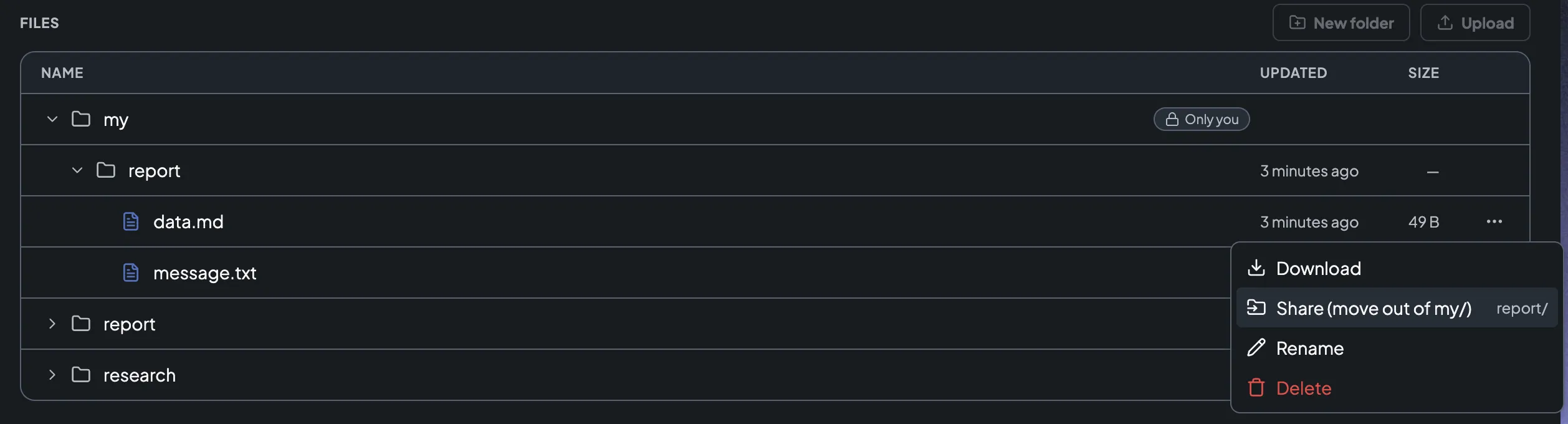
Your chats start on the shared side, so a request that does not say where to put the result puts it there — visible to every member as soon as it is written. Name my/ for anything you are not ready to show ("keep the working notes in my/"), and remember that a View only mode turns the same mistake into a failed write instead of an unwanted share.
A View only work mode lets you read every file in the folder and write only in my/; writes to the shared side are refused. The work itself is unaffected — you run the folder's actions and keep your analysis, drafts, and outputs under my/ — but nothing you produce is visible to the other members while this is your only mode. Publishing a result takes a mode that writes somewhere on the shared side, which a manager grants.
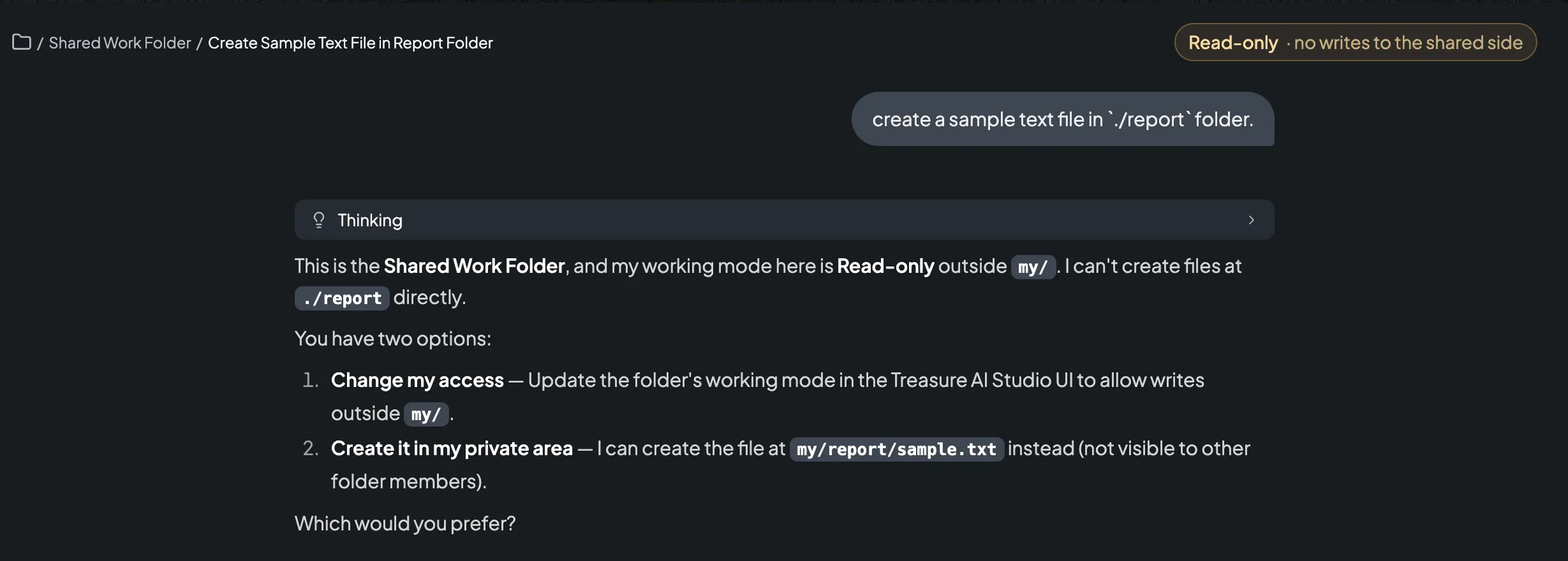
Sharing a file is a deliberate move, not a setting. On the folder page or in the sidebar file tree, open a row's ⋯ menu and select Share (move out of my/) — when your mode writes to several folders on the shared side, the item expands into one entry per destination. Dragging a row out of my/ works the same way.
Ask the AI for the file and move it yourself; that is the intended division of labor. Where your mode cannot write, row actions are disabled with the reason "You can't add or edit in the shared part of this folder — it's view-only for you."
The reverse move — pulling a shared file back into my/ — follows the same rule from the other side: it takes a mode that can write the place the file is leaving, because removing it from the shared side is itself a write there.
Moves refuse to overwrite: if the destination already has a file of that name, the move fails with "A file named '{name}' already exists there. Delete it or rename before moving."
A shared work folder has one set of instructions, and they belong to the folder: the CLAUDE.md at its root, applied to every member's chats. The Work folder settings dialog shows it as Folder instructions, with the note "Applied to every member's chats in this folder (the folder's CLAUDE.md)."
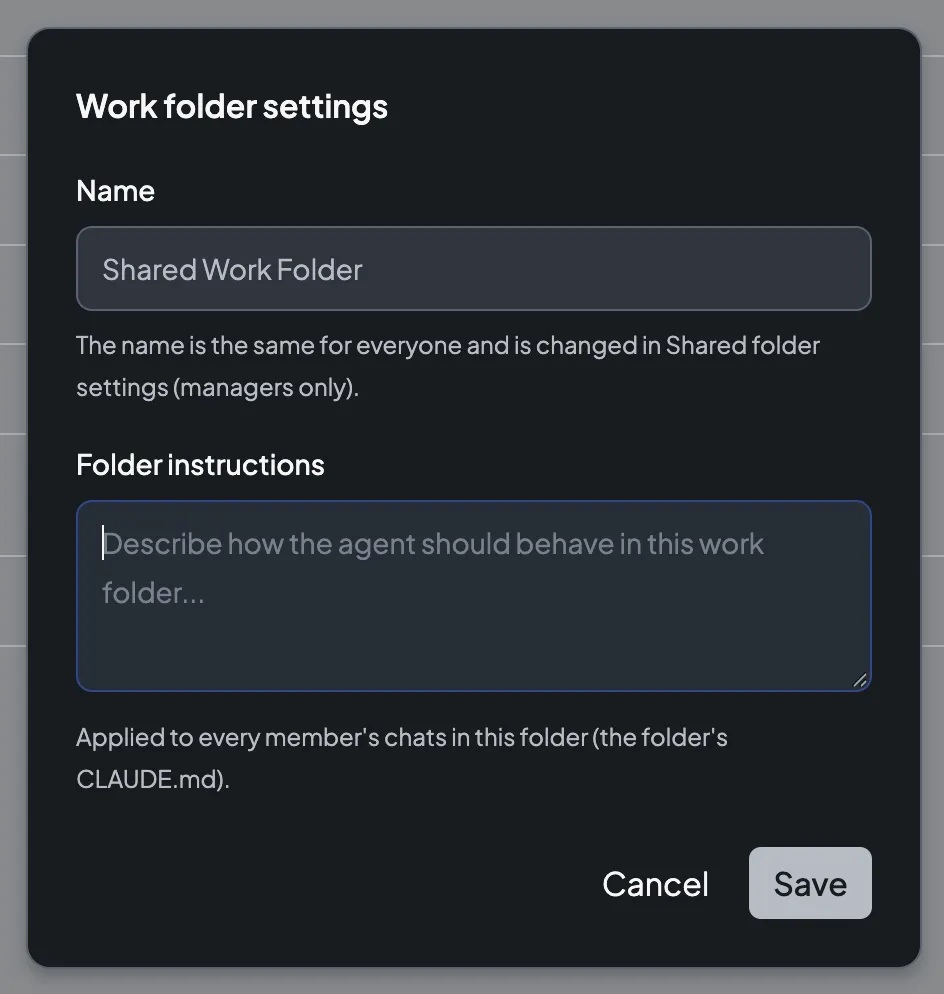
Editing them takes a work mode that can write the whole folder. Without one the field is shown read-only with the reason "View only — editing needs a work mode that can write the whole folder, and your current modes can't. Still applied to every member's chats." The folder's name is read-only for the same kind of reason: it is the same for everyone and only managers change it, in Shared folder settings.
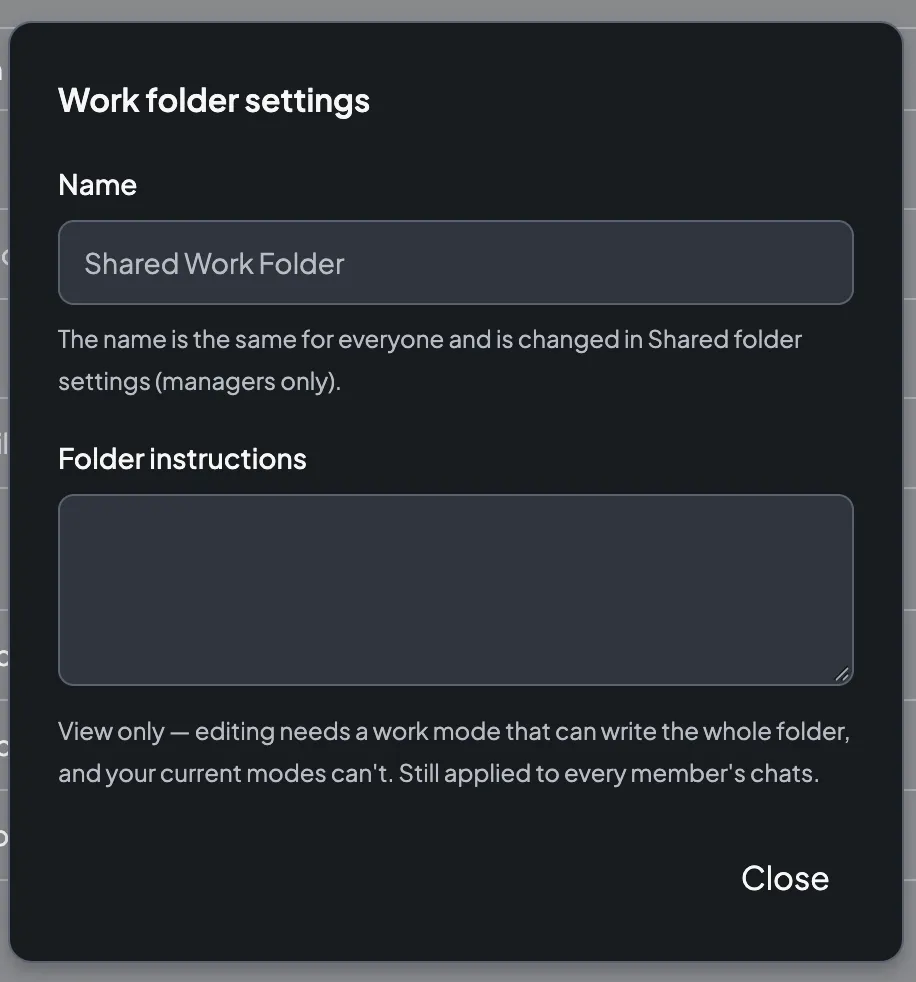
The folder's instructions are the only ones it applies, and they are the same for everyone. A CLAUDE.md you keep under my/ is an ordinary file: the AI may read it while working in my/, like any other nested file, but it is never added to your chats the way the folder's instructions are. For standing guidance of your own, use a private work folder, whose instructions are yours to write — and an account administrator can set an account-wide custom instruction that reaches every chat in the organization.
A shared work folder keeps its skills and actions in one place: its own .claude/skills/, on the shared side. Every member can run them, and maintaining them takes a mode that can write there — which is why the Share… dialog publishes .claude by default when a folder is converted.
A .claude directory under my/ is ignored, so a private variant of one of the folder's actions has nowhere to live. A shared work folder also cannot be the target when you bring a shared plugin's skills in for development: the picker offers private folders only, with the note "Private folders only — a shared folder's skills live in its shared tree, where development copies can't be installed."
Scheduling an action works as it does anywhere, with two additions in a shared folder: the schedule runs as you, under your work mode, and every member can see the folder's whole automation inventory — each schedule's action, cadence, and who it Runs as. Managers can take a schedule over with Become executor when the person who built it is unavailable.
Publishing skills from a shared work folder to your account's plugin registry is not supported — the Develop tab lists private work folders only. See Sharing Custom Skills.
Every chat in a shared work folder runs as one work mode, fixed for the session. The folder page shows your current mode as a badge next to the folder name — the mode's name and its effect, in amber when it is restricted — and each chat's breadcrumb row ends with the same badge, whose tooltip reads "This chat's work mode — the next session runs as the folder's current mode. Change it on the folder page."
Read that chip in the future tense: it names the mode the folder is set to now, which is the mode the next session will use. A chat you stop and resume comes back under the folder's current mode, not the one it started with.
To change modes:
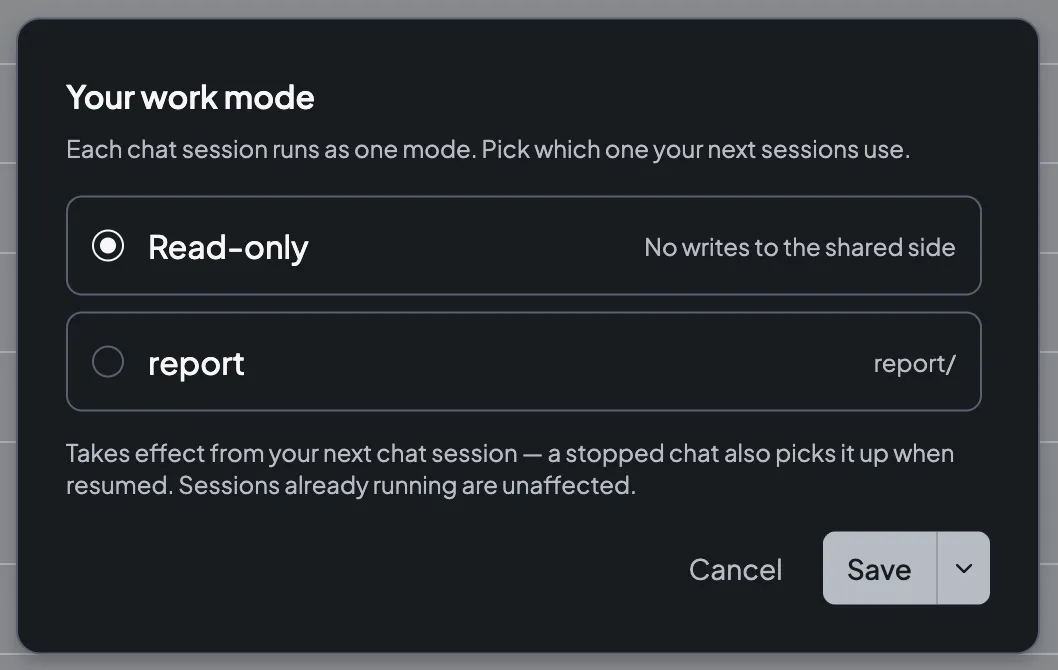
- Select the mode badge on the folder page. The Your work mode dialog lists the modes you may use with the scope each one grants.
- Select the mode you want to work in.
- Save it: Save applies it to your next chat session, and Save & start new chat applies it and opens a chat in it immediately.
The change takes effect from your next session — "a stopped chat also picks it up when resumed. Sessions already running are unaffected." If the mode you want is not listed, a manager has to grant it; the folder's managers are named on its catalog card and in Shared folder settings.
A manager can remove the mode you were working in. When that happens the folder stays in your sidebar, but its page shows "Your work mode for this folder is no longer available. Until you switch modes, its files can't be shown, new chats can't be created here, and other chats can't see this folder." with a Switch mode button, and the mode badge reads "no longer available — switch modes". New chats are refused until you pick a mode you still hold; if you hold none, a manager has to grant one. Your schedules in the folder fail in the meantime, and repeated failures switch them off — see Losing a Work Mode.
Leaving a shared work folder is a delete on your side only: it removes your copy of the folder, and the shared tree and every other member's work stay exactly as they are.
Removing a shared work folder deletes your chats in that folder and everything under your my/. The shared side is untouched — nothing you published is lost — but your drafts and notes are. Move anything you want to keep into another work folder first. Re-importing later gives you an empty my/.
Open the folder's ⋯ menu in the sidebar and select Delete, then confirm. The confirmation is the same one used for a private work folder ("This action will delete the work folder and all its chats"), and on a shared work folder it applies to your copy of it: your chats and your my/ area. If the folder is your default work folder, set another folder as default first — Delete stays disabled until you do.
| Issue | Solution |
|---|---|
| "Your work mode for this folder is no longer available." | The mode you were working in was taken away. Select Switch mode and pick one you still hold; if the dialog offers nothing, ask one of the folder's managers — named on its catalog card — to grant a mode again |
| The folder's files, uploads and actions are missing from its page | If the banner at the top says your work mode is no longer available, that is the cause — those sections come back as soon as you switch to a mode you hold. Otherwise reload the page to refresh the listing; if a manager deleted the folder, its page reports that instead |
| "You can have up to 25 active work folders. Delete one to import this folder." | You are at the work folder limit, counting private and imported shared folders. Delete a folder you no longer use, then import again |
| The mode you need is not in the picker | Only modes you are assigned — or whose scope fits inside one you hold — are listed. Ask a manager for the mode; Manage is never available without an explicit assignment |
| The AI says it cannot write somewhere in the folder | Your work mode does not cover that location. Write under my/ and share the file when you have access, switch to a mode that covers it, or ask a manager to extend the mode |
| A file the AI produced is not visible to your colleagues | It was written under my/ — either you asked for that, or your work mode could not write where it tried. Move it out of my/ when you have access — see Sharing a File from Your Private Area |
| An action you could run yesterday is gone from the folder | Its definition left the shared side — most often .claude was never published when the folder was converted, or someone moved it into their my/. Publishing .claude back to the folder restores it, and any schedule that auto-disabled can then be switched on again |
| The folder shows "{name} (shared)" instead of its real name | You have a private work folder with the same name. Select the Name adjusted badge, rename your private folder, then choose Use official name |
- Shared Work Folders — The layout, what is shared, and what stays yours
- Work Modes — What each access level grants, and when a change reaches your chats
- Work Folders — Default folders, where new chats are saved, and working across folders
- Organizing Files in a Work Folder — Uploading, moving, and downloading a folder's files