Sharing turns a work folder of your own into a shared work folder that your colleagues can import and work in. Everything you have taught the folder — its structure, its CLAUDE.md instructions, its skills and actions, its reference files — becomes a setup other people run with their own AI, instead of a routine only you can perform.
Do it when a workflow stops being personal: the report someone else has to produce while you are on leave, the reference material three people keep re-uploading, the action you have explained twice this month. When the work is collective from the outset — a new campaign the team will run together — you do not have to start privately at all: create the folder shared and skip the conversion. This page covers the manager's side of the whole life cycle — creating the folder, choosing what becomes visible, publishing it to specific people, and running it afterwards.
Sharing is a one-way door in one respect: a shared work folder cannot be turned back into a private one. Everything else about it is reversible, including who has access.
- Signed in to Treasure AI Studio on Web or Desktop (Getting Started)
- A work folder to share, if you are converting an existing one — it must not already be shared
- Fewer than 25 active work folders, if you are creating a new one
- The email addresses of the people you intend to share with; they must be in the same Treasure AI account
A shared work folder is either converted from one of your own or created shared from the beginning. Which one you pick depends on whether the work already exists as yours.
| Approach | When to Use It |
|---|---|
| Share… on an existing work folder | The work already exists as yours. A routine you have been running alone is now the team's. The folder is converted in place: nothing is copied and its chats keep working. Its contents move into your private area, and you pick in the same dialog what to publish to the shared side. Open it from the folder's ⋯ menu in the sidebar or on the folder page |
| New shared folder in the catalog | The work is the team's from the start. A workflow nobody has built yet, or one you would rather assemble in place — a shared reporting folder for a campaign that kicks off next week. Starting shared saves the curation pass entirely, because nothing personal has accumulated to sort out. Open the Work folder catalog with the + button next to Work Folders in the sidebar, then use New shared folder in its header |
Either way, the folder appears in the catalog immediately in the Setting up state: everyone in the account sees its name, and only people with Manage can read its contents. Nothing you place on the shared side is readable by colleagues until you publish.
Converting flips what the folder's root means. Everything the folder holds today moves into your private area — the my/ directory — and the root becomes the shared side, which starts empty. The Share… dialog therefore asks one question: which of those items to publish back out to the shared side, where every member will see them. Whatever you leave unpicked stays in my/, and you can publish more later.
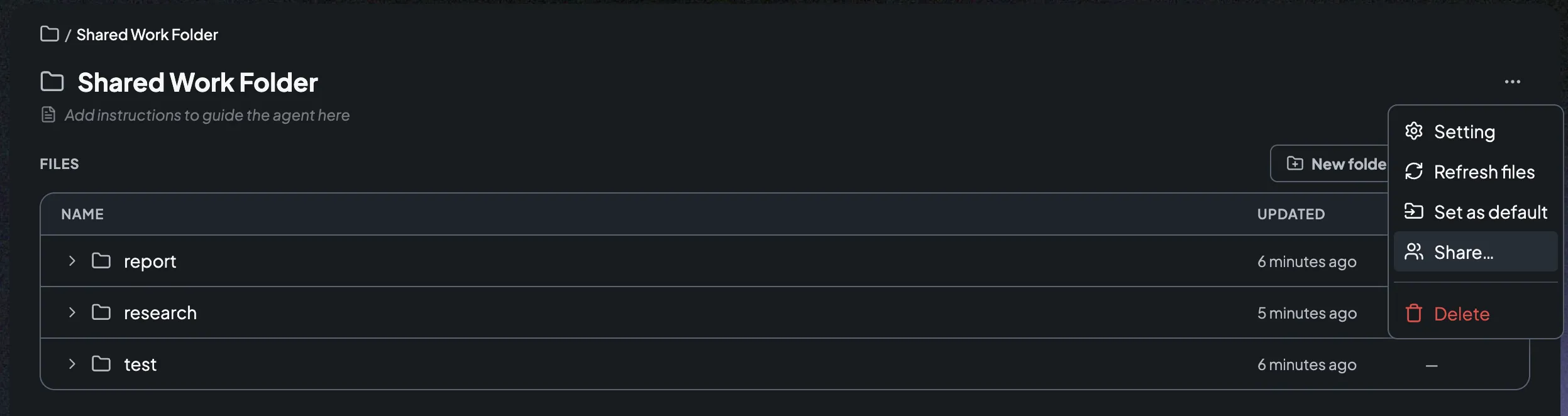
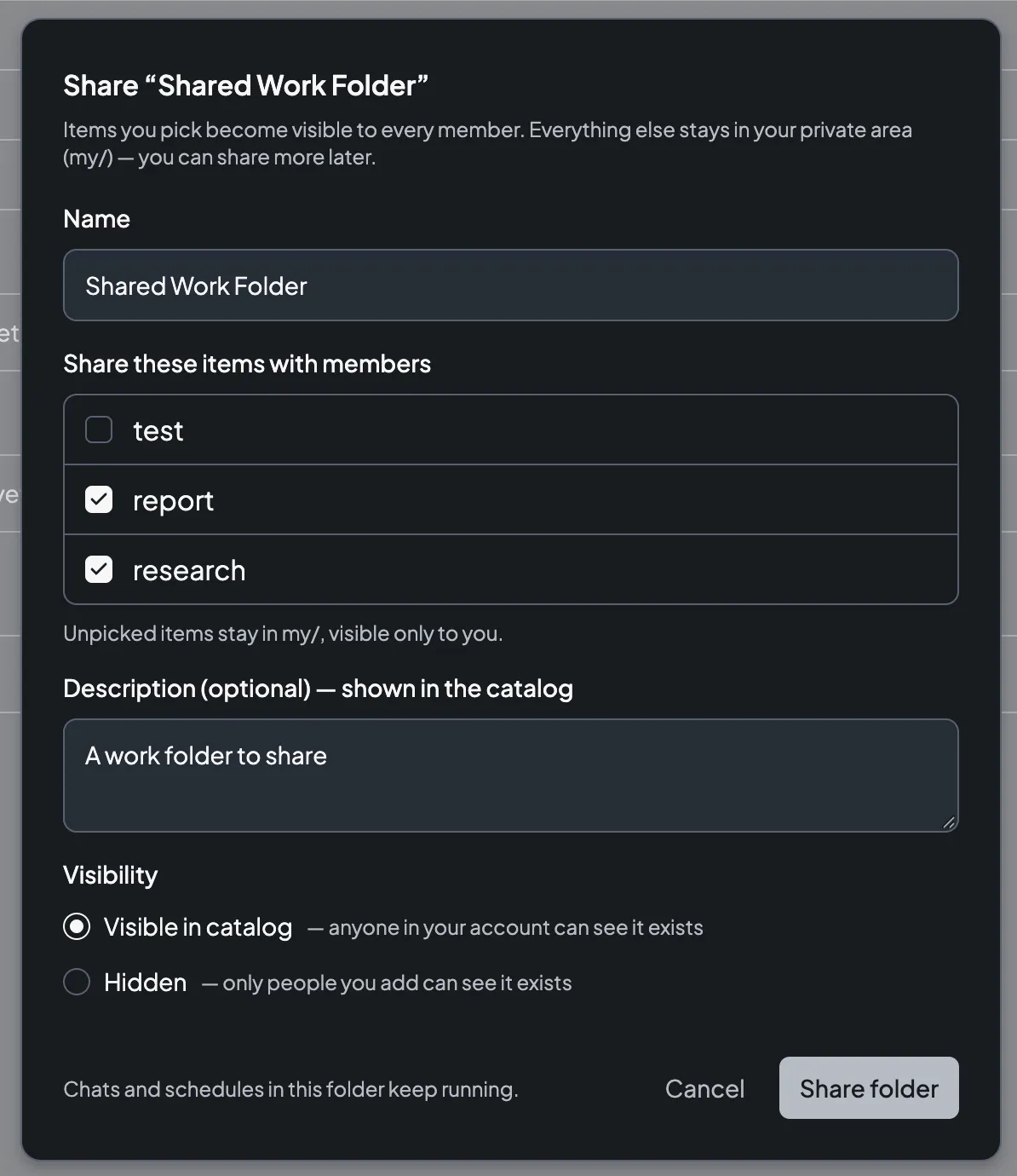
- Open the work folder's ⋯ menu — in the sidebar or on the folder page — and select Share…. The dialog is titled Share "{folder name}".
- Check the folder Name. It becomes the folder's name for everyone in the account, so make it recognizable outside your own context ("Q4 Campaign Reporting", not "work 2").
- Under Share these items with members, pick what your colleagues should get. Items are unpicked by default, except for the three the dialog handles for you — described after this procedure.
- Write a Description. It is what colleagues read in the catalog when deciding whether to import, so name the deliverable and the audience.
- Choose Visibility: Visible in catalog (the default — anyone in your account can see the folder exists) or Hidden (only people you add can see it exists). Choose Hidden here if the folder's name is sensitive; a Setting up folder is already listed by name.
- Select Share folder. Treasure AI Studio converts the folder, then moves the picked items out of
my/one at a time, showing "Moving files… n/total". - Confirm the result on the folder page. A toast reads "{folder name} is now a shared folder", the file list shows the items you published alongside a
my/row badged Only you, and a banner explains that only people with Manage can see the contents.
Your chats in the folder keep working. What changes is where new work lands: chats now start on the shared side, and your own drafts belong under my/. Paths in older chats still point at the old locations, so a transcript that says uploads/report.pdf now means my/uploads/report.pdf.
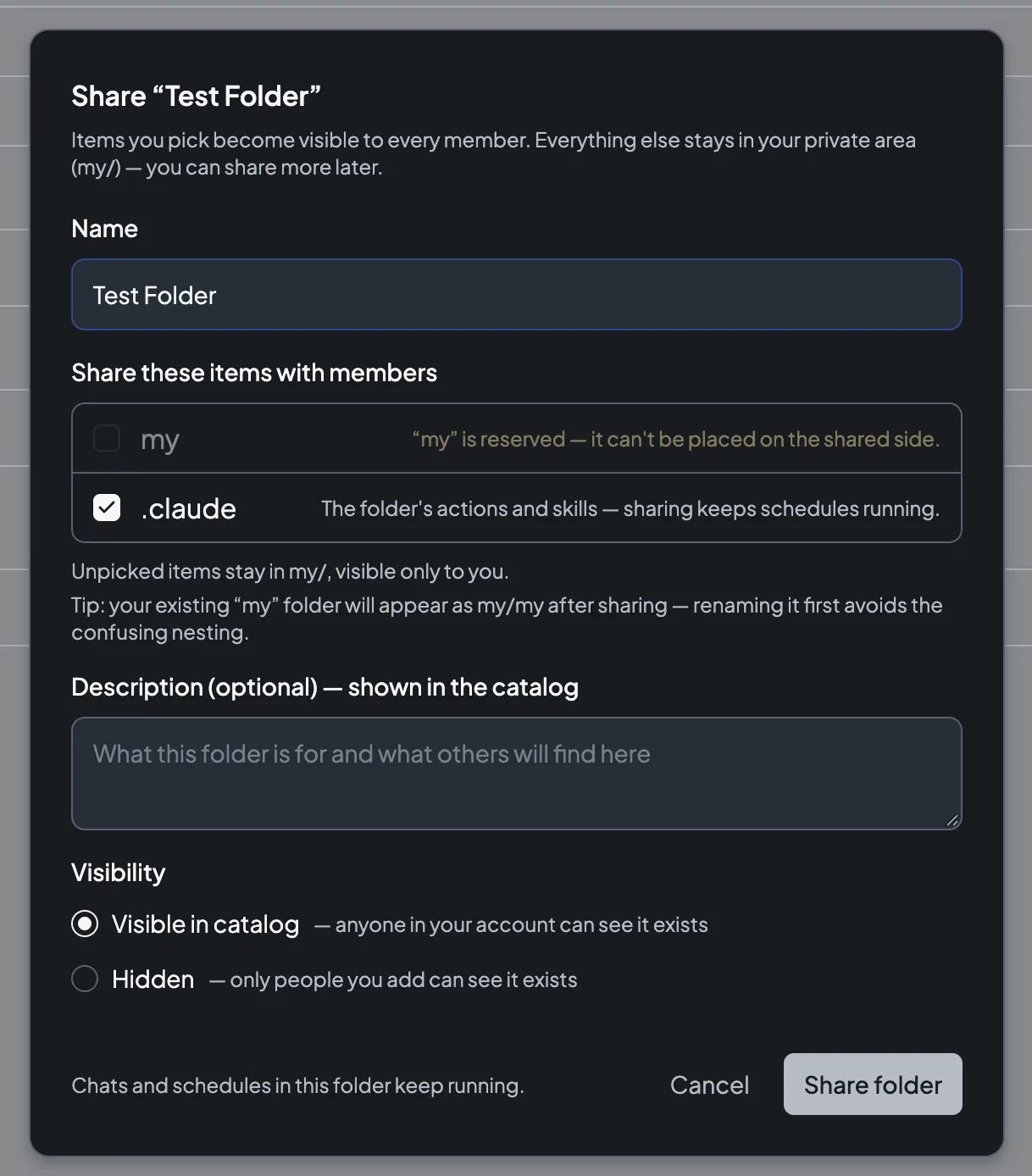
Both are picked by default, and for the same reason: a shared work folder resolves its instructions and its actions from the shared side only. Leaving .claude behind moves the folder's actions into my/, where Treasure AI Studio no longer finds them — the dialog warns that "This folder has N action(s) and M schedule(s). They stop working until .claude is shared — schedules keep failing and will auto-disable." Leaving CLAUDE.md behind demotes the folder's instructions to an ordinary file in your private area. Both are recoverable: publish the item afterwards and the folder picks it up again.
Two items are handled for you. uploads cannot be published — chat attachments are written to my/uploads/ in a shared work folder, so publishing the directory would split your attachments between two places; the row is annotated "Chat attachments — stays in your area." And an item of your own named my is blocked, because that name is taken by your private area; it ends up nested as my/my, and the dialog suggests renaming it first.
Open the Work folder catalog with the sidebar's +, select New shared folder, then give the folder a Name, a Description, and a Visibility. Create & open takes you to the new folder, which starts empty apart from your my/ area, with the two seeded work modes and you as its only manager.
A folder that grew around one person usually needs a pass before it is worth handing over. Use the Setting up state for it: nobody but the folder's managers can read the folder yet, so an unfinished folder is safe to leave as it is for days.
The AI can do most of the work of preparing it, in a chat inside the folder — it has the context to do it well. Ask it to review what you published and what is still in my/, to rewrite instructions written for you into instructions written for the team, to point out files that assume something outside the folder (a personal connection, a skill you have installed only for yourself), and to flag anything that looks sensitive.
What the AI does not do is decide what becomes visible. Publishing a file — moving it out of my/ — is left to you deliberately, because that move is the act of sharing it. Do it by dragging rows in the file list, or with Share (move out of my/) on a row's menu.
Publishing is one action with two parts: deciding who gets in, and confirming what they will see. Both live on the Shared folder settings page, which you open from the shared work folder's ⋯ menu.
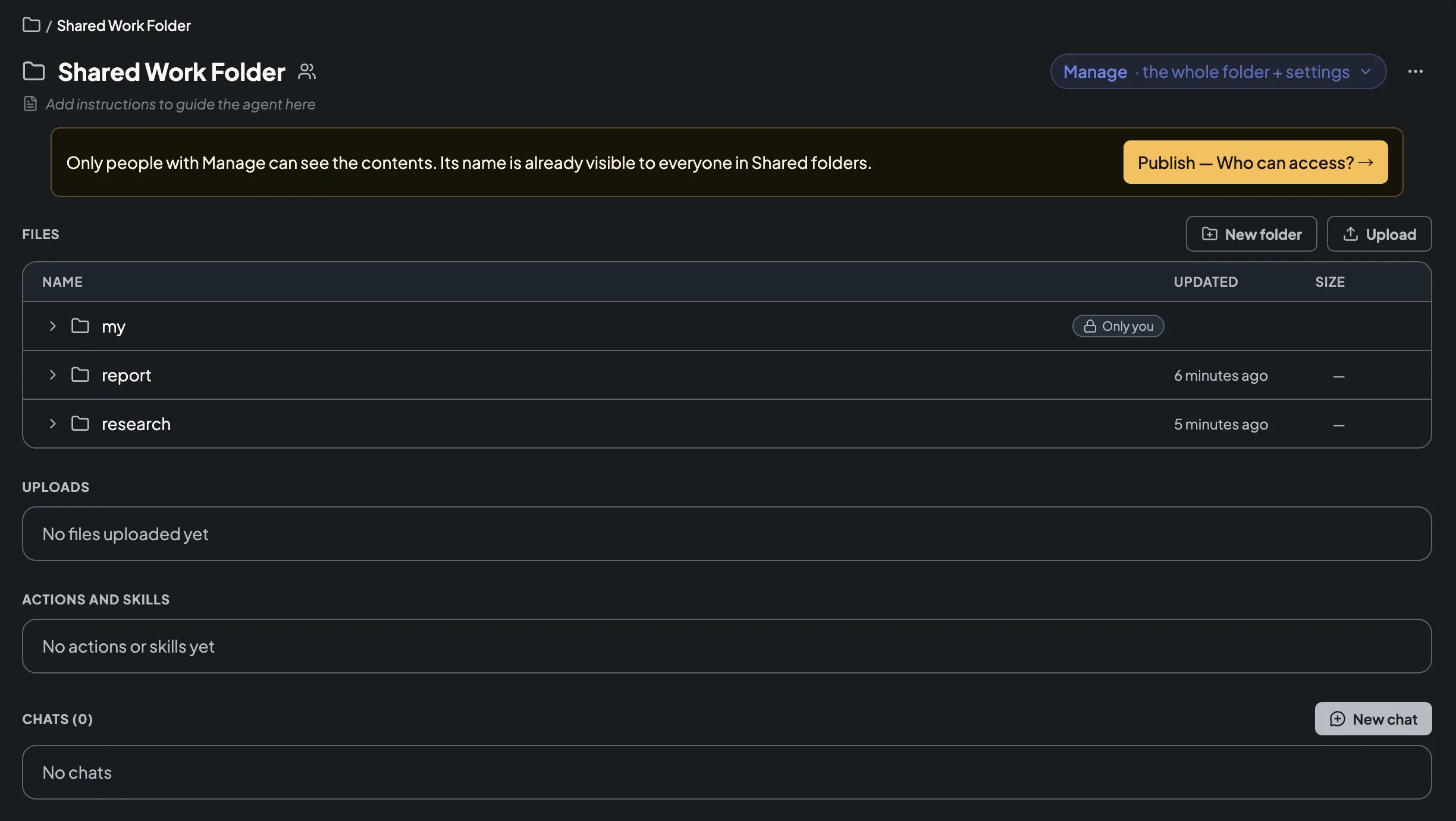
- On the folder page, select Publish — Who can access? → in the setting-up banner, or open Shared folder settings from the ⋯ menu.
- Select Add people.
- Search by email and select the people who need access.
- Under What may they do here?, check the work modes they should hold. To create a mode on the spot, check New mode, choose an access level, and name the top-level folders it may write to.
- Select Add. While the folder is still setting up, the grants are held as a draft, tagged on publish — nobody gains access yet.
- Repeat for the other groups of people. Use the Everyone in the account row on a mode when the whole account should have it — usually a view-only mode.
- Select Review & publish…. The dialog lists everything on the folder's shared side next to the people who are about to be able to read it, along with the catalog Description and the Hide from catalog setting to confirm.
- Read that list as your colleagues will see it — the last chance to catch something you did not mean to share. Move out appears on file rows and returns that file to your
my/area; to pull a whole directory back, close the dialog and move it from the folder page instead. - Select Publish shared folder. Access is granted, and the folder leaves the Setting up state.
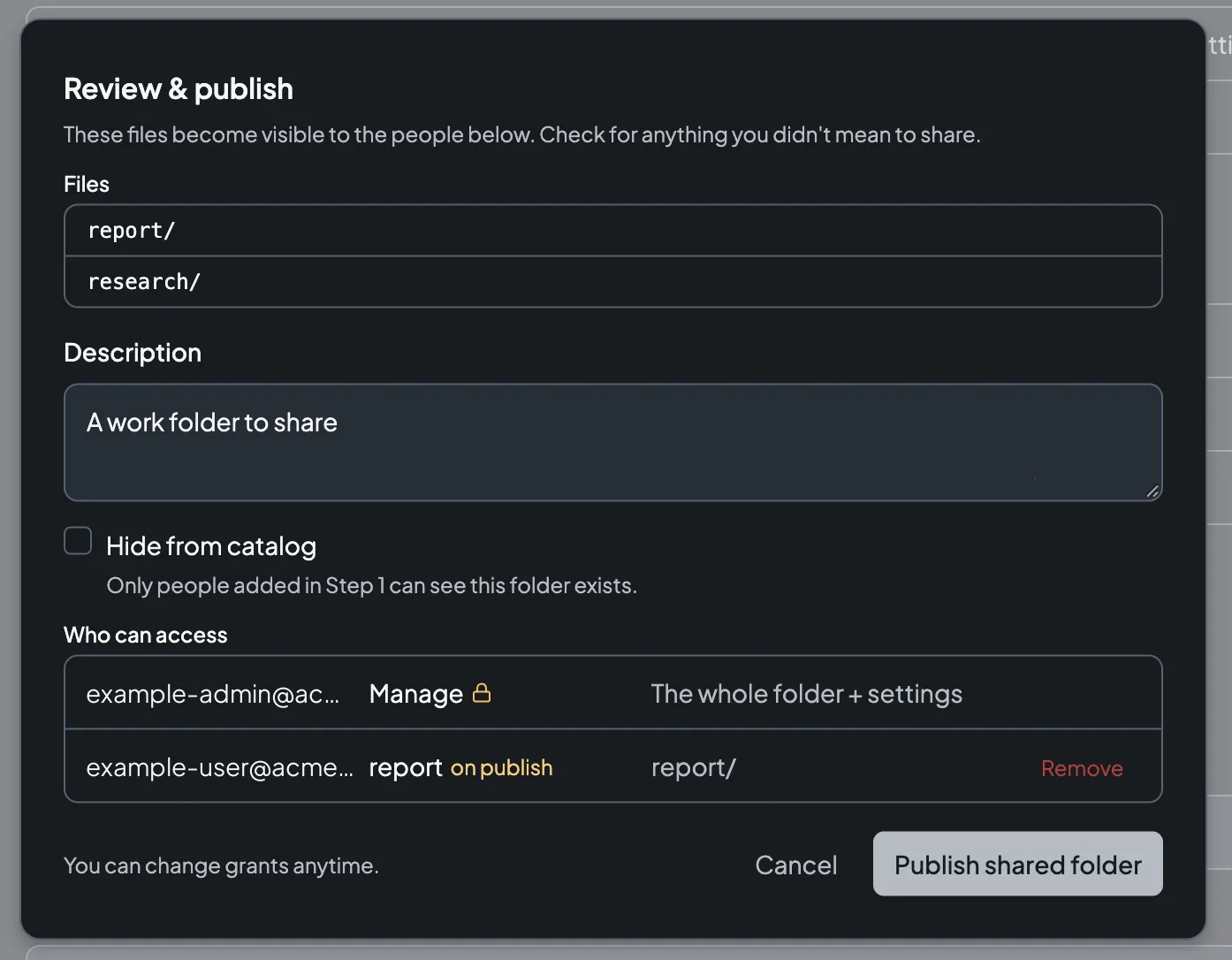
Each person now sees the folder in the catalog and can import it. They choose their work mode at import time, from the modes you gave them.
Grants added before publication live only in your browser. Closing the review dialog or navigating away asks "Discard N pending grants?", and discarding means re-adding the people. Everything else on the page — modes, folder settings — saves immediately when you save it.
Once published, the same Shared folder settings page is where the folder is run, and changes apply as you save them. Its sections:
| Section | What You Do There |
|---|---|
| People | See every person with the modes they hold and what those modes write to. Add people grants more access; Edit on a person's row sets exactly which modes they keep; Remove from folder takes all of their access away |
| Work modes | See the folder's modes with their members and write scope. Edit renames a mode or changes its writable folders; a mode can also be deleted, dropping its members to view-only on the shared side |
| Folder settings | Change the folder's Name and Description, or toggle Hide from catalog |
| Danger zone | Delete shared folder… — permanent, for every member |
Two behaviors are worth knowing before you change them:
- Renaming affects everyone at once. The name is the folder's canonical name, so a rename reaches every member without waiting for a new chat. A member who already has a private folder by that name sees the shared one as "{name} (shared)" with a Name adjusted badge, and can switch to the official name after renaming their own folder. Only managers can rename a shared work folder; other members see the name as read-only with the reason.
- Un-hiding requires a free name. A hidden folder may share a name with a visible one. Turning Hide from catalog off therefore re-checks the name, and if it is taken you are asked to rename the folder first.
For what takes effect when — and what a member sees the moment they lose their last work mode — see When a Change Takes Effect.
Deleting a shared work folder removes it from every member's workspace and permanently deletes its files, including every member's my/ area. There is no export and no undo: "There's no export — move any files you need out first." Chats that are running in the folder are stopped.
If your goal is to stop sharing rather than to destroy the folder, do not delete it. Remove people's work modes instead — the folder returns to Setting up once nobody but a single holder has access, and you keep every file.
To delete a folder for good:
- Move anything worth keeping into a private work folder —
my/goes with the folder too. - Open Shared folder settings from the folder's ⋯ menu.
- Scroll to Danger zone and select Delete shared folder…. The confirmation states how many members lose access.
- Type the folder's name to confirm.
- Select Delete.
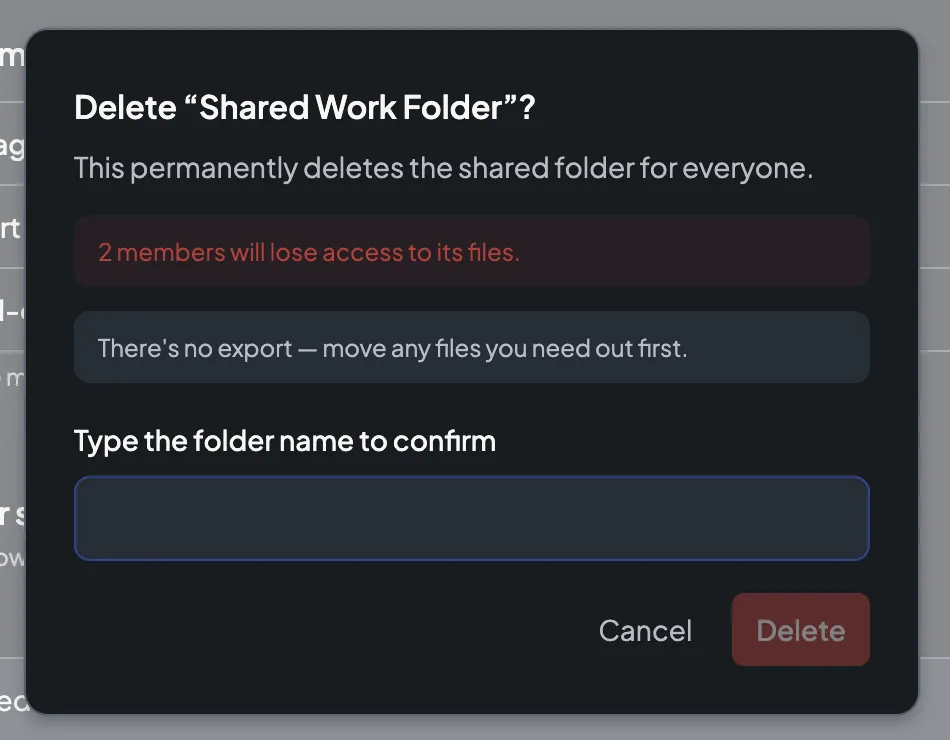
Each member's chats in the folder and their own area are deleted along with it, and members whose default work folder it was are left without a default until they pick one.
| Issue | Solution |
|---|---|
| Share… is missing from a folder's ⋯ menu | The folder is already a shared work folder — a folder cannot be shared twice, and there is no reverse conversion |
An item named my cannot be picked in the share dialog | That name is your private area's mount point, so nothing can be published under it. The item ends up as my/my after sharing; rename it first if the nesting is confusing |
| "Some files couldn't be moved" during conversion | Each item moves separately, so a failure leaves the rest in place. Retry remaining re-runs only what is left. A name that already exists on the shared side is refused rather than overwritten — rename one of the two and retry |
| "Settings saved, but granting access failed." | The description and visibility were saved but the grants were not. Select Publish shared folder again; it re-sends only the grants |
| "The folder was created, but we couldn't finish setting it up." | The folder exists. Open it from the Work folder catalog and continue — nothing is lost |
| Only your own name appears under People after publishing | The draft grants were discarded before Publish — they are held in the browser until then. Add the people again and publish |
| A member says the folder is not in their catalog | It is Hidden and they hold no work mode in it, so it is invisible to them. Add them to a mode, or turn off Hide from catalog |
| The folder's actions stopped running right after you shared it | .claude was left unpicked, so the actions are in my/ where the folder cannot resolve them. Publish .claude out of my/ and re-enable any schedule that auto-disabled in the meantime |
| The folder still shows Setting up after you added someone | The tag clears when access reaches beyond a single person. Check that the grants were published rather than left as drafts, and that the person is assigned a mode in the People section |
- Work Modes — Access levels, assignments, and how a chat picks the mode it runs as
- Using a Shared Work Folder — What your colleagues do next, from import to first chat
- Shared Work Folders — The layout of a shared work folder and what is shared versus private
- Actions — Package the workflow you are sharing as something members run with one click