The Snowflake connector lets Treasure AI Studio agents explore and visualize data in your Snowflake warehouse during a chat. Setup has three parts: an administrator creates an OAuth security integration in Snowflake, configures the connector in Treasure AI, and then each user authorizes their own connection.
Read Connections first for the general model — the difference between a connector and a connection, and the administrator vs. user roles. This page covers the Snowflake-specific steps.
Set up the Snowflake connector end to end: create the Snowflake OAuth security integration, configure and enable the connector in Treasure AI, and authorize a connection so the agent can query your warehouse.
- Account administrator privileges in Treasure AI Studio (for the connector configuration steps)
- A Snowflake account with the
ACCOUNTADMINrole (or another role that can create a security integration) - The account URL of the Snowflake account you want to connect
Treasure AI connects to Snowflake using an OAuth security integration that you create in your Snowflake account. The setup uses a confidential OAuth client with refresh tokens.
Find your Account URL. In Snowsight, click the account selector at the bottom-left, select your account, and copy the account URL. It has the form
https://ORGNAME-ACCOUNTNAME.snowflakecomputing.com. You'll enter this as the Account URL in Treasure AI (Step 2).Create the integration. Run the following SQL as
ACCOUNTADMIN. Replace the redirect URI with the callback URL shown in the Setup Guide on the Treasure AI connector form (it ends in/connections/callbackand is specific to your region):CREATE SECURITY INTEGRATION TREASURE_AI_STUDIO_INTEGRATION TYPE = OAUTH OAUTH_CLIENT = CUSTOM OAUTH_CLIENT_TYPE = 'CONFIDENTIAL' OAUTH_REDIRECT_URI = 'https://<your-region-host>/connections/callback' OAUTH_ISSUE_REFRESH_TOKENS = TRUE OAUTH_REFRESH_TOKEN_VALIDITY = 7776000 ENABLED = TRUE;Retrieve the client credentials. Run:
SELECT SYSTEM$SHOW_OAUTH_CLIENT_SECRETS('TREASURE_AI_STUDIO_INTEGRATION');From the output, copy
OAUTH_CLIENT_IDandOAUTH_CLIENT_SECRET. IgnoreOAUTH_CLIENT_SECRET_2— you only need the first secret.
For more detail, see Snowflake's guide on Configure Snowflake OAuth for custom clients.
The connection authorizes the agent with Snowflake's PUBLIC role. The agent can only query objects that PUBLIC can access, so grant the PUBLIC role the privileges it needs: USAGE on a warehouse (required to run any query), USAGE on the databases and schemas, and SELECT on the tables you want the agent to explore. The role is fixed at authorization time and cannot be changed from within a chat.
Because PUBLIC is automatically granted to every user in the Snowflake account, any privilege you grant to PUBLIC for the agent also exposes that data to all other users. Grant only what the agent needs, and consider whether a more restricted setup is required for sensitive data.
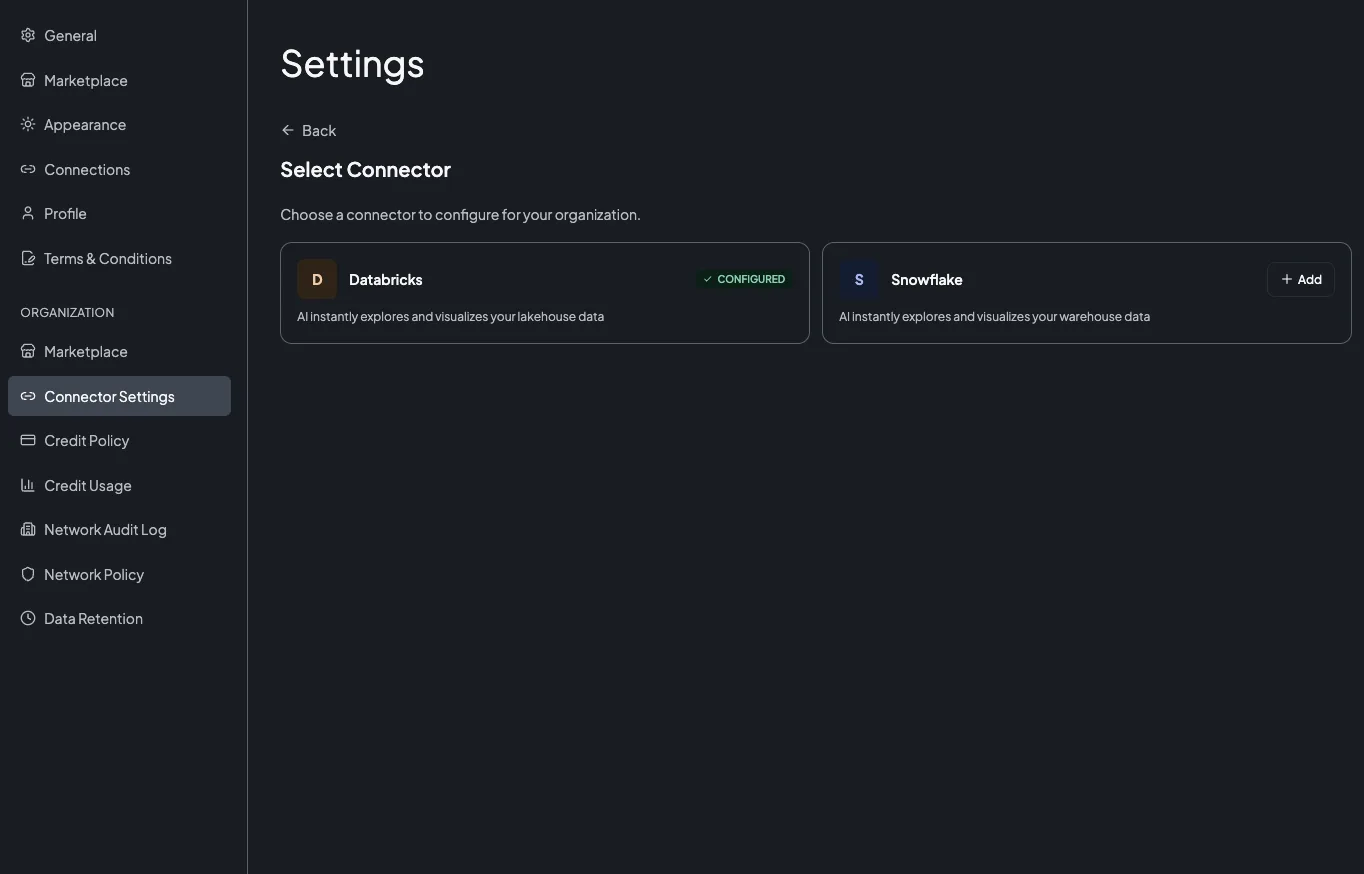
- In Treasure AI Studio, open Settings → Connector Settings (under Organization).
- Click Add Connector and choose Snowflake.
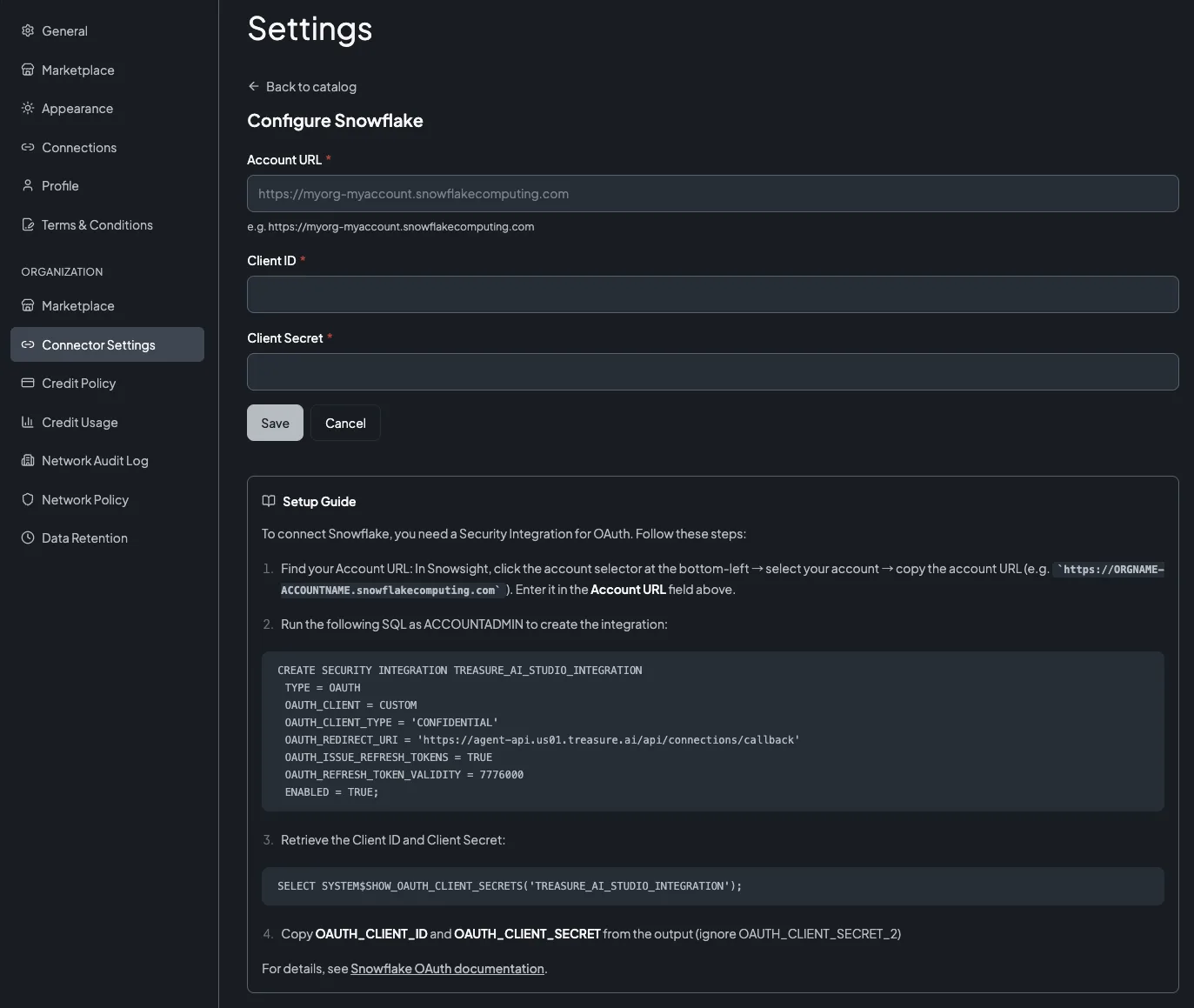
- Complete the form:
| Field | Value |
|---|---|
| Account URL | Your account URL from Step 1, e.g. https://myorg-myaccount.snowflakecomputing.com. |
| Client ID | The OAUTH_CLIENT_ID from the security integration. |
| Client Secret | The OAUTH_CLIENT_SECRET from the security integration (entered as a masked field). |
- Use the Setup Guide panel on this form as your reference — it contains the exact redirect URL to register in the security integration (Step 1) and the SQL to run.
- Click Save. The Snowflake connector now appears in your configured list.
- Make sure the connector is enabled so users can authorize connections to it.
If your account uses a network policy, allow the connector's egress domain (your Snowflake account host, e.g. myorg-myaccount.snowflakecomputing.com) so the agent's sandbox can reach it. The required domain is shown next to the configured connector in Connector Settings.
Each user who wants the agent to access Snowflake authorizes their own connection:
- Open Settings → Connections.
- Under Available, find Snowflake and click Connect.
- Sign in to Snowflake in the popup and approve the requested access.
- When the popup closes, Snowflake appears in your connected list with the date you connected it.
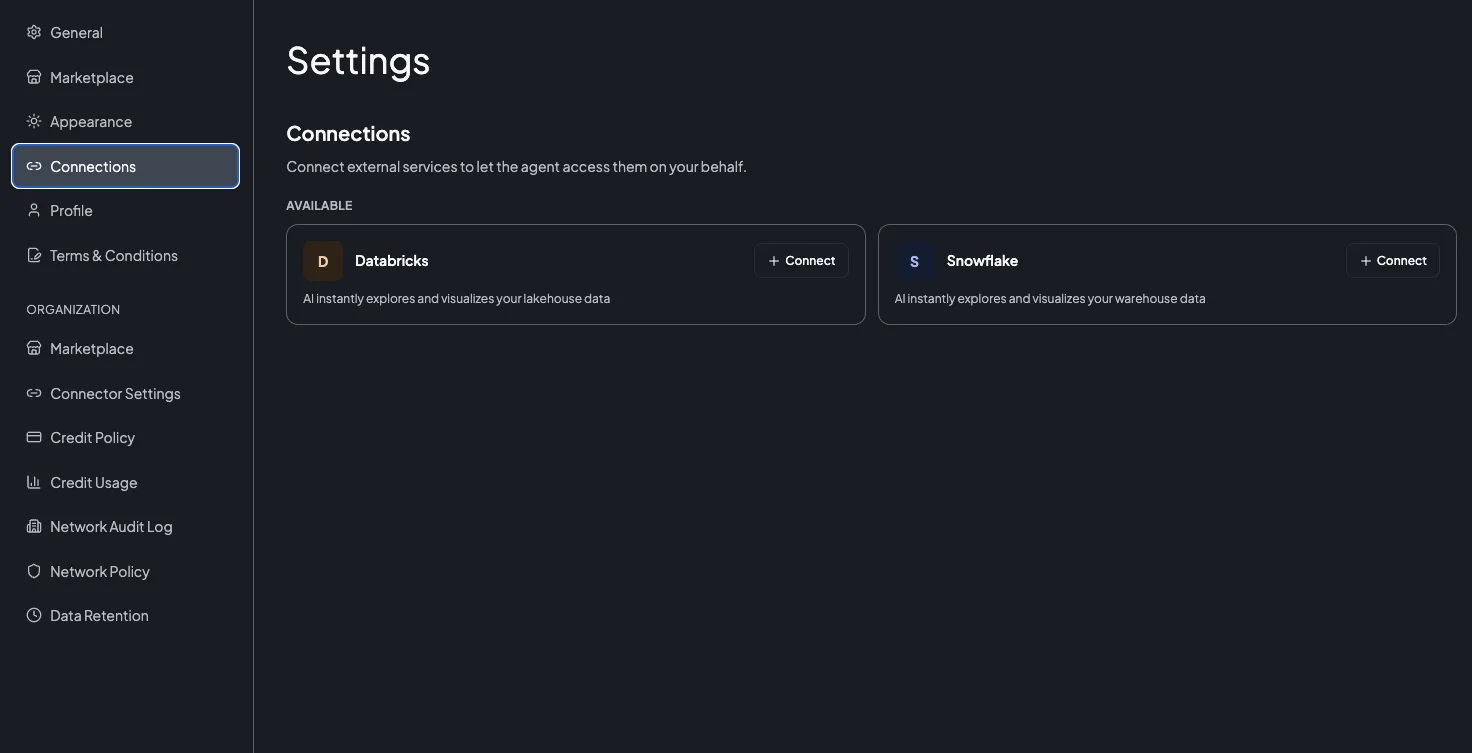
To remove the connection later, click the delete (trash) icon next to it.
You don't have to authorize in advance. If you ask the agent to work with Snowflake before you've connected, it shows a Connection Required card in the chat — click Connect there to run the same authorization without leaving the conversation. See Connect from a chat.
Once connected, ask the agent to work with your Snowflake data — for example, to explore a table or visualize a query result. The agent runs SQL against your warehouse and uses your connection automatically; no extra configuration is needed in the chat.
| Item | Value |
|---|---|
| Connector | Snowflake |
| Authentication | OAuth 2.0 (user-to-machine), confidential client with refresh tokens |
| OAuth scopes | refresh_token, session:role:PUBLIC |
| Agent role | PUBLIC (fixed by the OAuth scope) |
| Required configuration | Account URL, Client ID, Client Secret |
| Redirect URL | Shown in the connector form's Setup Guide (ends in /connections/callback) |
| Issue | Solution |
|---|---|
| Snowflake isn't listed on the Connections tab | An administrator must add the Snowflake connector in Connector Settings and enable it. |
| OAuth popup shows a redirect URL error | The OAUTH_REDIRECT_URI in the security integration must exactly match the callback URL shown in the connector form's Setup Guide. Re-run the CREATE SECURITY INTEGRATION (or ALTER SECURITY INTEGRATION) with the correct value. |
| The connection stops working after about 90 days | Refresh tokens are valid for 90 days (OAUTH_REFRESH_TOKEN_VALIDITY = 7776000 seconds in Step 1). Reconnect from Settings → Connections to re-authorize. |
| The connection authorizes but the agent can't reach Snowflake | Allow your Snowflake account domain in your network policy (see the egress domain shown in Connector Settings). |
| The agent connects but can't see your tables | Grant the PUBLIC role privileges on the databases, schemas, and tables you want the agent to query. |
| "Account URL" is rejected | The URL must be your account host in the form https://<orgname>-<accountname>.snowflakecomputing.com. Use hyphens (not underscores) between the organization and account names. |
| Saving the connector fails on the client secret | Re-run SELECT SYSTEM$SHOW_OAUTH_CLIENT_SECRETS('TREASURE_AI_STUDIO_INTEGRATION'); and copy OAUTH_CLIENT_SECRET again — make sure you copied the first secret, not OAUTH_CLIENT_SECRET_2. |
- Connections — The general connection model and administrator controls
- Connect Databricks — Configure and authorize a Databricks connection
- Reading Query Results — How the agent's output reaches you, and how to export it
- Getting Reliable Answers — Why answers vary, and where to define your conventions
- Charting a Result — Turning a query result into a chart